- Ahmed Atia
- General
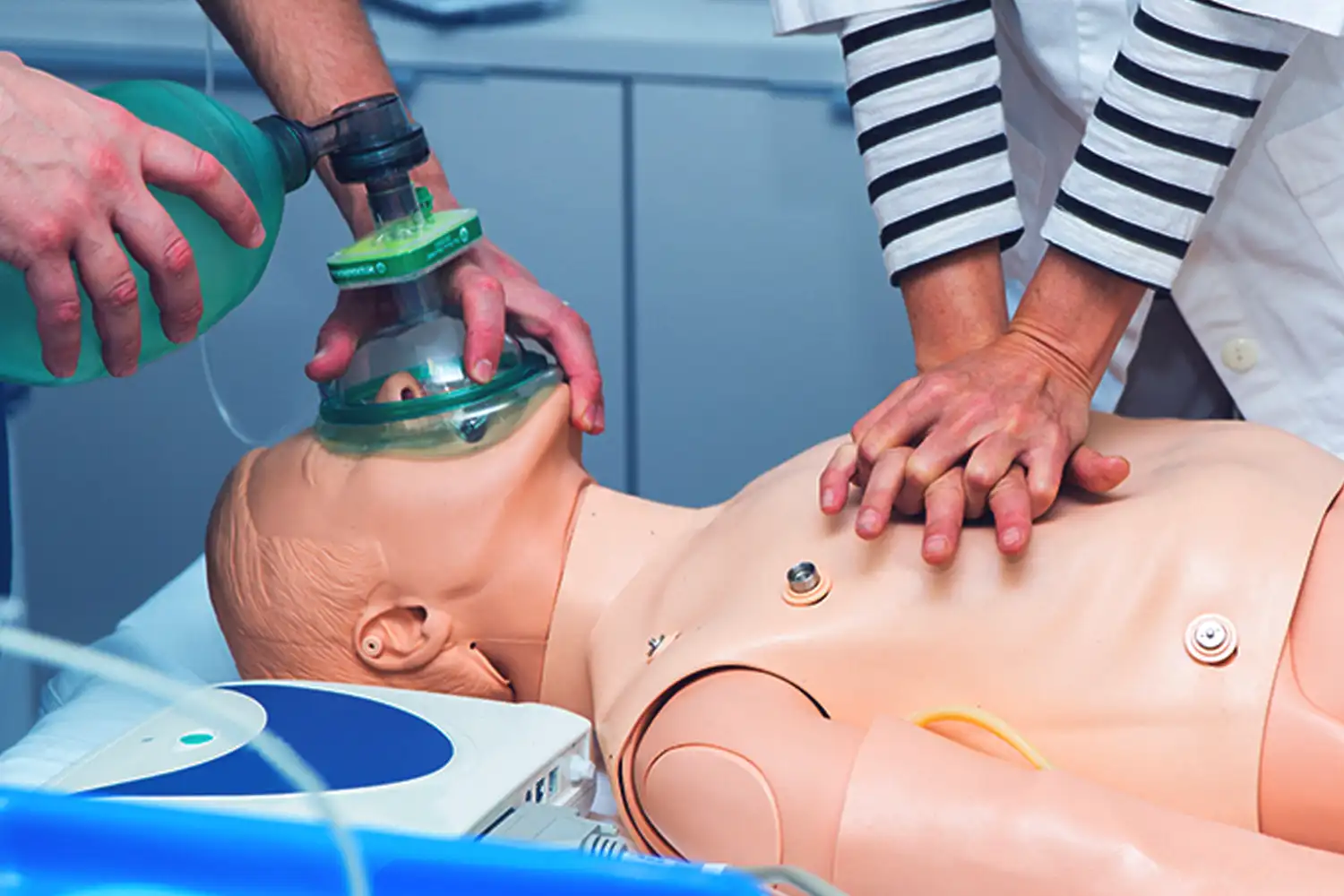
Of the most important health training programs that healthcare practitioners should learn are Cardiopulmonary Resuscitation (CPR) courses, as they play a vital role in saving lives and enabling professionals to handle critical cases with confidence and high efficiency, by the will of Allah.
Through training at Roya Al Mustaqbal Health Training Center, practitioners gain practical knowledge and master the approved procedures for cardiac and respiratory resuscitation in various emergency situations.
What is Cardiopulmonary Resuscitation (CPR) and Why is it Essential?
CPR is an immediate life-saving procedure performed when the heart or breathing suddenly stops, such as in cases of drowning, heart attacks, or choking.
This procedure helps restore blood flow to the brain and other organs temporarily, giving the patient a chance to survive until the specialized medical team arrives.
Studies have shown that mastering CPR skills can triple the chances of survival compared to cases where the procedure is not properly performed.
Cardiac arrest can occur suddenly to anyone, and having even one trained person nearby can make a miraculous difference. For this reason, learning CPR is crucial to making a life-saving medical impact in emergency cases.
The trained practitioner helps stimulate blood circulation, allowing partial blood flow through the heart—offering a two-out-of-three chance to save someone from sudden death.
A person may need CPR in cases such as drowning, cardiac arrest, or when breathing stops or becomes insufficient. The rescuer must perform 120 chest compressions per minute and ensure that breathing is checked within no more than 10 seconds.
You don’t have to be a medical specialist—anyone can take health training at an accredited center like Roya Al Mustaqbal Health Training Center, one of the leading health training institutions in Saudi Arabia.
Importance of CPR Courses for Doctors and Healthcare Practitioners
When doctors and healthcare providers take CPR courses, they:
Increase survival rates in emergencies, boosting public trust in them and in their healthcare institutions.
Enhance the efficiency of the medical team in managing critical situations.
CPR courses elevate the professional and social value of healthcare providers by improving their ability to help patients, enhance workplace reputation, and promote public health and safety.
For patients, CPR-trained professionals greatly improve survival chances and outcomes in emergencies—turning healthcare providers from mere observers into real lifesavers.
Start your journey to saving lives today!
Register in accredited CPR courses and learn emergency skills that can make the difference between life and death. Don’t wait for a crisis—be ready, confident, and equipped now. Contact us at: 966920035022
The Best Accredited CPR Courses in Saudi Arabia
Roya Al Mustaqbal Health Training Center offers a variety of certified medical training programs accredited by the Saudi Commission for Health Specialties (SCFHS) and internationally recognized bodies such as:
American Heart Association (AHA)
Saudi Heart Association (SHA)
National Association of Emergency Medical Technicians (NAEMT)
American College of Surgeons (ACS)
Society of Critical Care Medicine (SCCM)
Available accredited courses include:
Basic Life Support (BLS)
Advanced Cardiovascular Life Support (ACLS)
Pediatric Advanced Life Support (PALS)
Neonatal Resuscitation Program (NRP)
Prehospital Trauma Life Support (PHTLS)
Advanced Trauma Life Support (ATLS)
Fundamental Critical Care Support (FCCS)
These programs are available on-site or online, in a modern training environment equipped with the latest medical simulation technologies. Participants receive locally and internationally accredited certificates. Click here to view more courses.
CPR Steps: What Will You Learn in These Courses?
Each CPR course aims to equip trainees with the necessary skills to become competent healthcare practitioners capable of handling emergencies.
1. Basic Life Support (BLS):
By the end of this course, trainees will master basic CPR skills, recognize emergencies, and learn proper chest compression and ventilation techniques, including managing choking incidents effectively.
2. Advanced Cardiovascular Life Support (ACLS):
Trainees will learn how to manage sudden emergencies such as cardiac arrest or stroke, perform advanced cardiac and respiratory support, understand emergency medications, and interpret electrocardiograms (ECG) accurately to make correct medical decisions.
3. Neonatal Resuscitation Program (NRP):
Designed for doctors and nurses in neonatal units, this course teaches how to resuscitate newborns, open airways, provide effective ventilation, and monitor vital signs after birth with precision and care.
4. Pediatric Advanced Life Support (PALS):
This course trains healthcare providers to manage pediatric emergencies, perform artificial ventilation, assess cardiac performance, and deliver appropriate medical care to critically ill children.
5. Prehospital Trauma Life Support (PHTLS):
Focuses on handling trauma patients before reaching the hospital, training medical teams to assess, stabilize, and transport patients safely.
6. Advanced Trauma Life Support (ATLS):
Accredited by the American College of Surgeons (ACS), this course trains doctors to manage trauma cases using evidence-based methods, including rapid assessment, stabilization, and safe patient transfer.
7. Fundamental Critical Care Support (FCCS):
Accredited by the Society of Critical Care Medicine (SCCM), this program focuses on key ICU management skills such as airway maintenance, ventilation, continuous vital sign monitoring, circulatory shock management, and proper use of critical medications following standardized protocols.
Cost of CPR Courses: Prices and Factors That Affect Them
The cost of CPR courses depends on several factors:
The type of course (basic vs. advanced).
The participant’s background (general individual, nurse, or physician).
The mode of learning (online or in-person).
Whether an accredited certificate is included.
Number of participants in a group.
Location and training facilities.
Materials and tools used in the training process.
Don’t hesitate to contact us now to learn about the latest prices and offers: 966920035022
A Certified Training Center for CPR Courses
Finding a certified training center that offers a wide range of CPR courses is rare—and if you’re here, you’re one of the lucky ones!
At Roya Al Mustaqbal Health Training Center, you’ll find top-quality accredited courses designed to enhance practical and research-based medical skills, offering professionals opportunities to advance their careers.
The center is officially accredited by the Saudi Commission for Health Specialties (SCFHS) and has been providing professional medical training since 2019, building a strong network of expert trainers with both local and international experience in the healthcare field.
More to read
See all
General
Health Crisis and Disaster Management: Effective Strategies for Handling Health Emergencies
Learn about the concept of health crisis and disaster management and the most important strategies used to reduce health risks, achieve rapid response, and protect individuals and institutions during emergencies and epidemics. Select 68 more words to run Humanizer.

General
Emergency Codes in Hospitals: A Comprehensive Guide to Understanding Medical Alert Signals
Learn about Emergency Codes in Hospitals, their meanings, and their role in saving lives, and how they help medical teams respond quickly to critical cases within healthcare facilities.

General
Remote First Aid Course to Learn How to Handle Emergencies with Confidence
Join Now the Best Remote First Aid Course and Learn How to Handle Emergency Situations Step by Step. Gain Essential Life Skills from Certified Experts and Be Ready to Save Lives Anytime, Anywhere.